

Robert Krulwich
Robert Krulwich works on radio, podcasts, video, the blogosphere. He has been called "the most inventive network reporter in television" by TV Guide.
Krulwich is the co-host of WNYC's Radiolab, a radio/podcast series distributed nationally by NPR that explores new developments in science for people who are curious but not usually drawn to science shows. Radiolab won a Peabody Award in 2011.
His specialty is explaining complex subjects, science, technology, economics, in a style that is clear, compelling and entertaining. On television he has explored the structure of DNA using a banana; on radio he created an Italian opera, "Ratto Interesso" to explain how the Federal Reserve regulates interest rates; he has pioneered the use of new animation on ABC's Nightline and World News Tonight.
For 22 years, Krulwich was a science, economics, general assignment and foreign correspondent at ABC and CBS News.
He won Emmy awards for a cultural history of the Barbie doll, for a Frontline investigation of computers and privacy, a George Polk and Emmy for a look at the Savings & Loan bailout online advertising and the 2010 Essay Prize from the Iowa Writers' Workshop.
Krulwich earned a Bachelor of Arts degree in history from Oberlin College and a law degree from Columbia University.
-
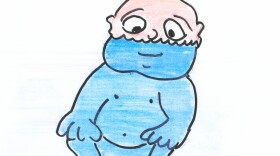 A fresh tomato is 93.5 percent water. A fresh baby girl or boy is 75 percent water. A banana, 74 percent. We all start wet, and then, inevitably, dry. A 1-year-old baby carries 10 percent less water; a male adult 15 percent less. Life is a slow evaporation, with some curious exceptions.
 -
 Ready, get set, go! Let's compare a sperm whale plowing through the ocean to a human sperm plowing through a glass of water: The whale barely notices the water it's in; the sperm — oh, gee — it's got a problem. How it solves that problem — being much closer to the size of the water molecules around it — is ... well, masterful.
 -
 If we had enough time, enough brain power, the right computers, the occasional genius, is there any limit to what we can know about the universe? Or is nature designed to keep its own secrets, no matter how hard we try to crack the code? What can we never know?
 -
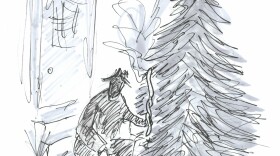 There was a spruce tree in Stanley's garden, and when September rolled around, a family of garden snakes used it to sunbathe. They'd squiggle out on a branch, flop down and warm themselves in the sunshine — sometimes dangling in braided pairs. Stanley, envious, decided to join in ... and here's what happened next.
 -
 Snails getting ready for winter are natural carpenters. They construct doors, or maybe you'd call them walls, inside their shells. They do this without hammers, nails or cement. Instead, they use their foot — and of course, their favorite material, mucus. Welcome to the ingenious world of snail construction.
 -
 Drones are for spying, right? Right. But if Jasper van Loenen's idea works, drones will also become private moving vans. Crows won't like this. Trees won't like this. I'm not sure I like this. But you've got to see Jasper's instant-drone deliver a bicycle wheel across campus ...
 -
A New York design team has just produced an invisibility cloak for your cellphone. Pop it in and no government, no merchants, no friends, no one knows where your phone is. Another design team in Canada says it could do stuff like this — but it won't. Who's right?
-
 What surgeons see when they open us up and look inside is not pretty — unless you're a surgeon. But when designer Kelli Anderson opens us up, we are feathery, pipe filled, ivory-boned, wired, clean, elegant — just gorgeous. Plus, we are entirely made of colored paper. Check out this new transparent (and interactive!) human body — perfect for kids.
 -
Why did it take cells so long to link together and form tissues, organs, you, me, turtles, daisies? There was a couple of billion year pause before cells became multicellular. How come? With brilliant designer Paolo Ceric, we consider this puzzle of life.
-
 Spring comes, then summer, fall and winter and if you are off the planet with a camera looking down at Earth, the seasons seem like breaths. Speed up the imagery, and the planet seems to pulse, like a living thing. Take a look at what designer John Nelson has done. It's uncanny.


